

„Because the kingdom of one language and morality is poor and weak“
Contribution of members of non-Slovak ethnicities and nationalities
to development of Slovakia
International conference organised on the occasion of the 80th birthday of PhDr. Jozef Klačka
Bratislava, 14th – 15th November 2018

In hospitibus et adventitiis viris tanta inest utilitas... Nam unius linguae uniusque moris regnum, imbecille et fragile est. Propterea jubeo te, fili mi! Ut bona voluntate illos nutrias et honeste teneas, ut tecum libentius degant quam alibi habitent (In guests and foreigners there is such a great benefit... for the kingdom of one language and morality is poor and weak. That is why I command you, my son, to nourish them and honour them with good will, so they would rather spend time with you than dwell elsewhere.)
This very quote from Decrees of St. Stephen King, who teaches his son Emeric of Hungary about wise rule, has become the name and at the same time the motto of our conference focusing on the importance and the contribution of members of non-Slovak ethnicities and nationalities to the development of Slovakia. There can be no doubt about the importance of personalities such as Johann Nepomuk Hummel, Maximilian Hell, Joseph Maximilian Petzval, members of only one of the nationalities living in the territory of Slovakia. Former Hungarian kingdom was a country where many languages were spoken. Perhaps names of people such as Josip Andric and Ferdinand Takáč, members of Croatian ethnicity, or Chatam Sofer and Eugen Rosenberg from the Jewish milieu will be known to some people. The number of nationalities that have lived in the territory of modern Slovakia is larger still: Hungarians, Romanians, Romas, Serbs, Poles, Bulgarians, and Ukrainians. However, individuals who came to us from foreign countries were also of great importance. Already from the end of the Middle Age and subsequently during the modern era Italian masters were active in our territory. For example, military engineers from Italy were invited here during the reign of Sigismund of Luxembourg, just like important scholars as Antonio Bonfini of Ascoli, Aurelio Brandolini or Pietro Ranzano were summoned by Mathias Corvin. Even later on under the Habsburg rule, many Italian masters, whose work has been preserved in the form of architectural works, paintings and sculptures, came to our territory. As examples we can name Pietro and Gotthard Spazzo, Andrea Pozzo, Marco Antonio Canaval, Andreo Pocabello, Pietro Battista, and Giovanni Rosso. After the battle of White Mountain (Bílá Hora) a large number of Czech exiles arrived in Hungarian kingdom, the best known among them the humanists Jakub Jakobeus and Juraj Tranovský or sculptor Dionýz Ignác Stanetti of Silesian origin.
From a global perspective on other ethnicities or nationalities an extremely interesting one is the phenomenon of the impact and influence of Ottoman culture, which has left its marks in our environment. In the first half of the 20th century, our society has been enriched by Czech intelligence and officials, or Russian emigrants. After World War II, our country has become the homeland for Greeks and later for members of Vietnamese ethnicity or for a number of students from the Near East and Africa. Primarily the conference focuses on personalities from national and ethnic groups, both of all-national and regional importance, who have contributed to the development of culture, science, technology, economy or even the social sphere. The intention is to draw attention to the less well-known aspects of research on the subject. Secondary, however, we also welcome sociological, historical and ethnological articles, focusing on the relations of the newer ethnicities coming to Slovakia in the 20th century in general and their overall life in new environment. Last but not least, the current refugee question is also relevant for the conference. Are today's emigrants a threat or a benefit? Are there obvious parallels with the past?
Thematic areas:
- Personalities of wider importance originating from non-Slovak nationalities who lived or are living in our territory
- Personalities of regional or local importance from non-Slovak nationalities who lived or are living in our territory
- Personalities who came from foreign countries and worked in our territory
- The establishment of foreign ethnicities in toto, which came into territory of Slovakia in the modern and contemporary period
- The current refugees in the historical continuity of the emigration process in our territory
PhDr. Jozef Klačka
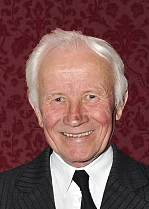 The conference is organised on the occasion of the 80th birthday of the archivist and historian PhDr. Jozef Klačka,
a former director and long-time employee of the Central Archive of SAS, who is himself a member of the Croatian minority in Slovakia
and has made a significant contribution to the historical research of the Croatians and their settlement in the west of Slovakia.
From 1st June of 1960, shortly before his graduation in history and archival studies at the Faculty of Arts of Comenius
University in Bratislava, he started to work in State archive in Bratislava. In 1969 he became an employee in Central Archive
of SAS, where his efforts contributed a lot to the development of said institution. Between 1978 and 1999 he held the post
of the archive’s director. As a member of Scientific Council of Slovak Archives he had a hand in the draft of the Act on Archives
and Registries. During his career he was a member of the Council of Scientist of SAS, Committee of Parliament of SAS, and
the Government Council for National Minorities. He is a laureate of the Križko’s Medal, an award for outstanding merits
in the field of Slovak archival science, of Matthias Bel’s Commemorative Medal, an award bestowed upon him by SAS. He has
been also presented with the Commemorative Medal of SAS and the award Outstanding Figure of SAS. Furthermore, he is a laureate
of Stanislav Staszic’s medal, awarded by Polish Academy of Sciences.
The conference is organised on the occasion of the 80th birthday of the archivist and historian PhDr. Jozef Klačka,
a former director and long-time employee of the Central Archive of SAS, who is himself a member of the Croatian minority in Slovakia
and has made a significant contribution to the historical research of the Croatians and their settlement in the west of Slovakia.
From 1st June of 1960, shortly before his graduation in history and archival studies at the Faculty of Arts of Comenius
University in Bratislava, he started to work in State archive in Bratislava. In 1969 he became an employee in Central Archive
of SAS, where his efforts contributed a lot to the development of said institution. Between 1978 and 1999 he held the post
of the archive’s director. As a member of Scientific Council of Slovak Archives he had a hand in the draft of the Act on Archives
and Registries. During his career he was a member of the Council of Scientist of SAS, Committee of Parliament of SAS, and
the Government Council for National Minorities. He is a laureate of the Križko’s Medal, an award for outstanding merits
in the field of Slovak archival science, of Matthias Bel’s Commemorative Medal, an award bestowed upon him by SAS. He has
been also presented with the Commemorative Medal of SAS and the award Outstanding Figure of SAS. Furthermore, he is a laureate
of Stanislav Staszic’s medal, awarded by Polish Academy of Sciences.


